TIME:2025-02-14 Source: This site
Basic structure and working principle of fluorine lined three-way ball valve
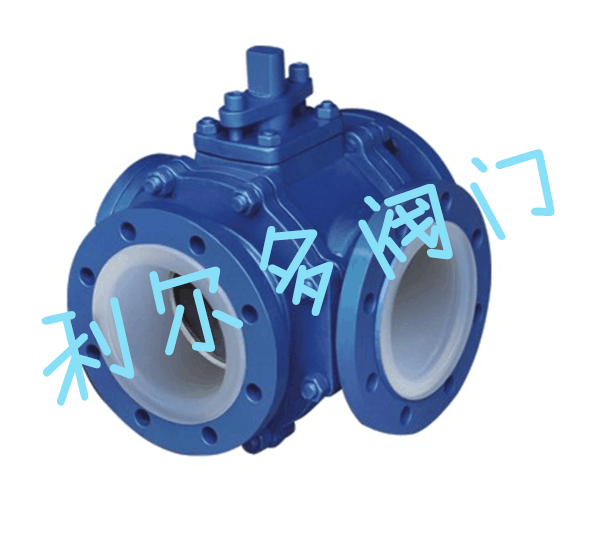
Fluorine lined three-way ball valve It is a special valve designed specifically for highly corrosive media, which achieves fluid flow direction switching, diversion, or merging control through the rotation of a sphere. It is widely used in corrosive working environments such as chemical, pharmaceutical, and electroplating. Its core advantage lies in the use of fluoroplastic lining technology inside the valve body and key contact surfaces, which combines excellent corrosion resistance and sealing reliability.
1、 Basic structural composition
1. Valve body structure The valve body is made by casting or forging process, and the inner wall and the surface of the flow channel in contact with the medium are uniformly lined with fluoroplastics (such as PTFE, F46, PFA) to form a corrosion-resistant barrier. The thickness of the lining layer is usually 2-3mm to ensure long-term impermeability.
2. Channel type *L-shaped tee (Q44F46 type): The inlet and outlet channels are distributed at right angles, and the spherical channel is L-shaped. The flow direction between two vertical pipelines is switched by rotating 90 ° (such as A → B or A → C).
*T-shaped tee (Q45F46 type): The flow channel is distributed in a T-shaped manner, and the spherical channel is a tee structure. The medium can be divided, merged, or switched in multiple directions (such as A → B+C, B → A+C, etc.) by rotating 90 ° or 180 °.
3. Sealing components *Elastic lip seal seat: made of fluoroplastic or reinforced composite material, with a "lip shaped" edge design. Under the pressure of the medium, the sealing lip tightly adheres to the surface of the sphere, forming a self tightening seal that can compensate for deformation caused by temperature changes.
*Sphere: The surface is coated with a layer of fluoroplastic or the whole is made of corrosion-resistant alloy, polished to a precision of Ra ≤ 0.8 μ m, ensuring a low friction fit with the sealing seat.
4. Drive device Supports manual (handle/worm gear), pneumatic or electric operation, and the valve stem and valve body are sealed with packing structure to prevent medium leakage.
2、 Working principle
1. Flow control mechanism Drive the valve stem to rotate through the driving device, causing the ball to rotate around the axis. The relative position change between the internal flow channel of the sphere and the flow channel of the valve body determines the flow path of the medium:
*L-shaped valve: The ball rotates 90 ° to switch the inlet and outlet flow directions, suitable for two-way alternating operations (such as switching between reactor feeding and emptying).
*T-shaped valve: The ball rotates 90 ° or 180 ° to achieve the merging, diversion, or cutoff of three media channels (such as a multi tank parallel circulation system).
2. Sealing principle of fluorine lined three-way ball valve *Low pressure condition: Initial sealing is achieved by relying on the pre tightening force of the sealing seat and the interference fit of the sphere.
*High pressure condition: The pressure of the medium pushes the lip of the sealing seat tightly against the sphere, and the higher the pressure, the stronger the sealing effect (self sealing effect).
*Temperature difference compensation: Fluoroplastic sealing seat has elastic memory characteristics and can adapt to temperature fluctuations of -50 ℃~200 ℃, avoiding leakage caused by thermal expansion and contraction.
The above is an introduction to the basic structure and working principle of fluorine lined three-way ball valves. Currently, this valve is widely used in chemical processes, environmental engineering, electroplating equipment, pharmaceuticals and other industries.